















Short answer: platinum-cured silicone is non-porous, has no plasticizers, can be washed hot and lasts for years. TPE is softer and cheaper, but it is slightly porous, holds onto oils and bacteria more easily, cannot be boiled and breaks down faster. For anything that goes on or inside your body, silicone is the safer long-term buy.
That is the summary most guides stop at. The more useful part is knowing why, and being able to check what a toy is really made of when the product page is vague. That is what this guide covers.
What is the difference between platinum silicone and TPE?
Silicone is a synthetic rubber built on a silicon and oxygen backbone. It is "cured" (set from liquid to solid) with a catalyst. With a platinum catalyst, the reaction is an addition cure that leaves no by-products behind. With a tin catalyst, it is a condensation cure that releases alcohol as it sets, and the part keeps shrinking slightly as that alcohol evaporates. Mould makers measure that shrinkage at about 1 to 3 percent over time, and tin-cured parts become brittle within a few years. Platinum-cured silicone is the grade used where skin contact matters, which is why it is the one to look for on a sex toy.
TPE (thermoplastic elastomer) is a family of plastics that behave like rubber at room temperature and melt when heated. That is what makes them cheap to mould, and also why they cannot be boiled. Many soft strokers and "realistic skin" sleeves are TPE or TPR (a close cousin). It feels very soft and squishy, which is its main selling point.
Then there is PVC "jelly", the glossy, translucent material common in cheap toys. It is not TPE, but it often gets lumped in with it, and it is the material with the worst track record (more on that below).
Is TPE safe? What the studies actually found
The honest answer is more nuanced than "TPE is toxic". The best-known lab study on sex toy materials is the Danish Environmental Protection Agency's 2006 survey (Survey of Chemical Substances in Consumer Products No. 77). Researchers bought 16 products and tested them. The headline findings:
- The most common material was soft PVC, and every product sold as "jelly" turned out to be soft PVC.
- 10 of the 15 samples tested contained phthalates (plasticizers). In the worst sample, the plasticizer DEHP made up 70.2% of the material by weight.
- The thermoplastic rubber (SEBS, a type of TPE) stroker in the study was one of the products the agency found to pose no health risk, even in worst-case use.
- Oil-based lubricant increased the migration of plasticizers out of the material. Water-based lube reduced it.
So the real villain in that study was phthalate-heavy PVC, not TPE as such. The problem with TPE is different: it is microporous. Its surface holds onto body oils, lube and bacteria in a way silicone does not, and since it melts under heat, you cannot sterilise it. You can only wash it. Over months, TPE also tends to go tacky, discolour and tear, which is why many TPE sleeves ship with a "renewing powder" to keep the surface from getting sticky.
Regulation does not save you either. In the EU, four phthalates (DEHP, DBP, BBP and DIBP) have been restricted to 0.1% in consumer articles that touch the skin since July 2020 under REACH. In the US, phthalate limits apply to children's toys, and researchers writing in Microplastics and Nanoplastics (2023) pointed out that adult toys have no materials or labelling standard at all. In their small sample, one product sold as "phthalate-free" contained phthalates.
Platinum silicone vs TPE: side by side
| Platinum silicone | TPE / TPR | |
|---|---|---|
| Porosity | Non-porous | Microporous, holds oils and bacteria |
| Plasticizers | None needed | Some formulas use oils or plasticizers to stay soft |
| Heat | Handles hot water; solid pieces can be boiled | Softens or melts, never boil |
| Feel | Dense, smooth, slightly grippy, holds detail | Very soft and squishy, can feel tacky |
| Smell | Odourless | Often a plastic or chemical smell out of the box |
| Lifespan | Years with basic care | Months to a couple of years |
| Lube | Water-based | Water-based |
| Price | Higher | Lower |
How to tell if your sex toy is silicone or TPE
Product pages are not always honest. "Silicone blend", "medical grade material" or "skin-safe TPE" usually mean something other than solid platinum silicone. Five checks you can do at home:
- Smell it. Platinum silicone has no smell. A strong plastic, vinyl or "new shower curtain" smell points to PVC or TPE.
- Stretch it. TPE stretches a lot and feels almost gummy. Silicone gives, then pushes back. It feels dense for its size.
- Look at the surface. Silicone holds sharp detail (scales, veins, fur texture) and stays matte or satin. TPE often looks slightly oily and picks up lint and dust easily.
- The paper test. Leave the toy on a sheet of paper overnight. If it leaves a greasy mark, it is leaching oil. Solid silicone does not.
- The flame test (only if you accept damaging it). Hold a flame to a hidden edge for a few seconds. Silicone resists, chars slightly and leaves a white-grey powdery ash. TPE and PVC melt, drip and smell of burning plastic. This test damages the toy, so use it on a scrap or base edge only.
Which one feels better?
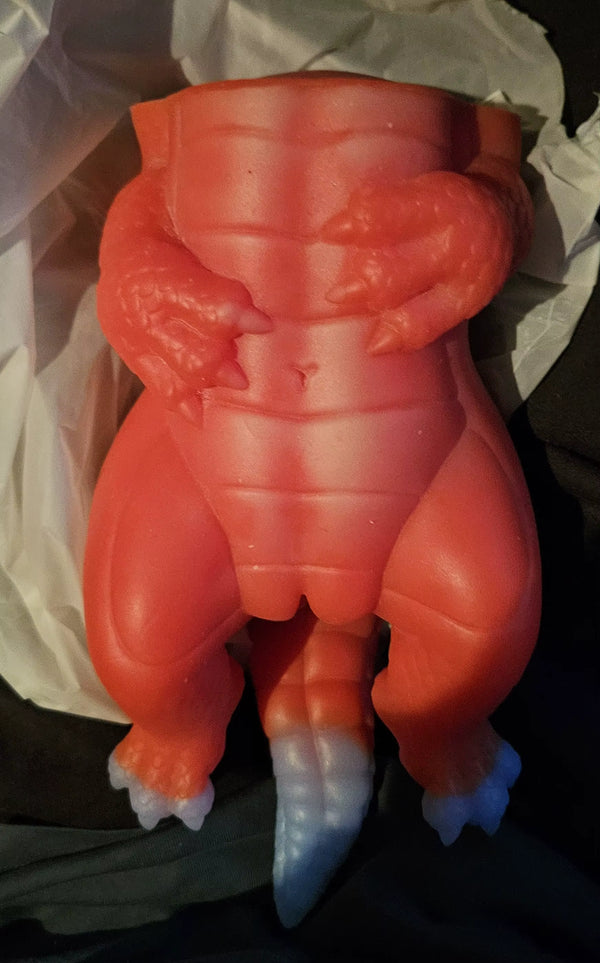
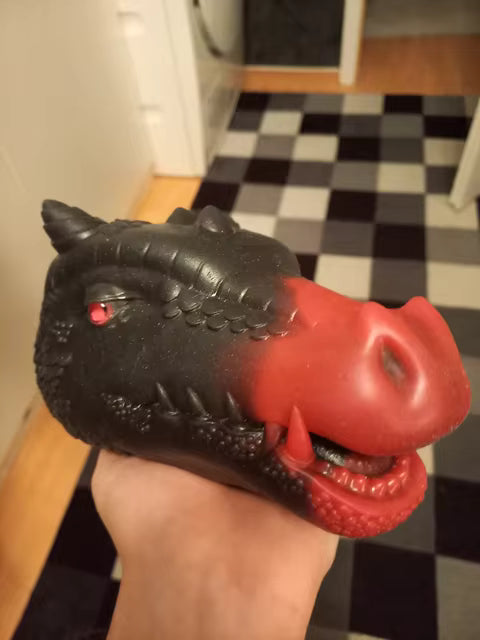
This is the part where TPE has a real argument. A soft TPE sleeve feels very forgiving, and some people simply prefer that squish. Silicone feels denser and more "alive" under pressure, and it holds sculpted detail much better, which matters a lot for fantasy shapes. A scale, a ridge or a knot keeps its edge in silicone; in TPE it softens and rounds off.
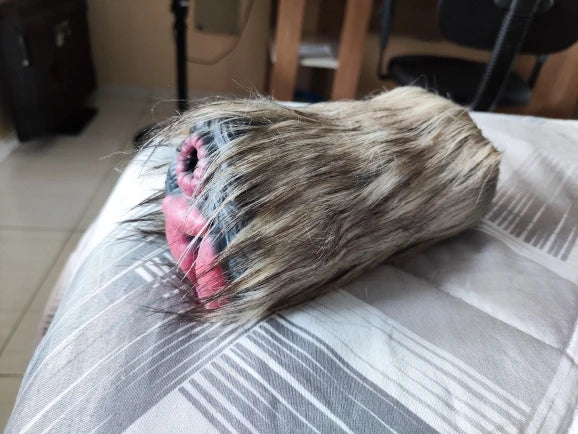
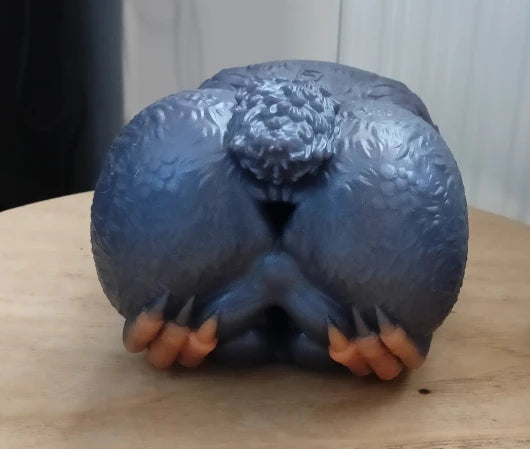
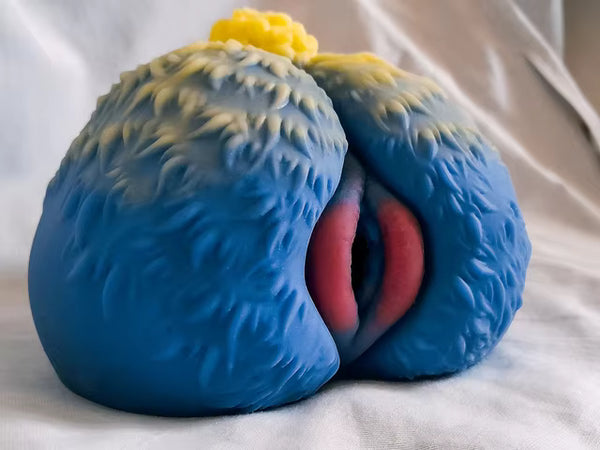
Silicone also warms up to body temperature and holds it. Heavier silicone pieces stay put on a bed or a table, which changes how you use them. On our furry masturbators, weight ranges from about 345 g to over 800 g, and on the butt masturbators some pieces pass 2 kg. That kind of mass is only practical in silicone.
Caring for each material
Silicone: warm water and a mild unscented soap after every use, rinse, then let it air-dry completely before storing. Solid, non-motorised silicone toys can be boiled for a few minutes if the maker allows it. If a toy is dual-layer (a firm core with a softer outer shell), follow the care card instead of boiling it. Our full routine is in the silicone toy cleaning guide.
TPE: warm water and soap, no heat, dry thoroughly (inside channels too, or it will grow mould), and dust with renewing powder or cornstarch if it gets sticky. Store it away from other toys, because some TPE reacts with other plastics.
Lube for both: water-based is the safe default. Silicone lube can bond with a silicone toy and make the surface swell or go tacky over days or weeks. If you really want to use one, test a drop on the base of the toy and leave it for 3 to 4 hours before trusting it.
What BeastyLov uses
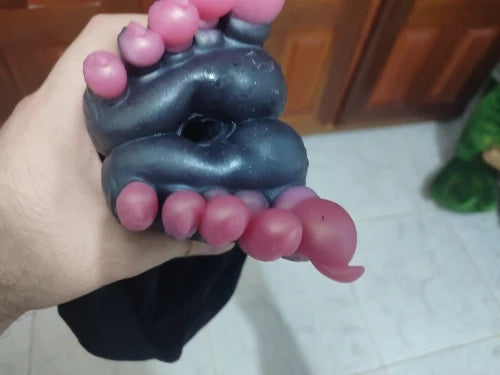
Every BeastyLov toy is cast in platinum-cured silicone: the channels of the furry, paw, head and butt masturbators, and every dragon, knot, horse and tentacle dildo. No PVC, no TPE. On furry pieces, the fur is synthetic plush on the outside only and never goes inside the body.
If a shop cannot tell you whether its silicone is platinum-cured, assume it is not.
FAQ
Is TPE body-safe?
TPE can be phthalate-free, but it is microporous, so it cannot be fully sanitised and should not be shared between partners or used with anything that carries bacteria between body areas. Wash it well and replace it once it gets sticky or discoloured.
Is "medical grade silicone" the same as platinum silicone?
Not necessarily. "Medical grade" is mostly a marketing term on sex toys, since there is no standard certification for them. Platinum-cured is the more meaningful thing to ask for.
Can I boil a platinum silicone toy?
A solid silicone toy with no motor usually can, for a few minutes. Dual-layer toys and anything with fur, electronics or glued parts should be washed with warm water and soap instead.
Why does my silicone toy feel sticky?
Usually leftover soap, lint or a reaction with silicone lube. Wash with warm water and a little soap, rinse well, and switch to water-based lube.
Can silicone toys touch each other in storage?
Platinum silicone is stable, but store pieces separately anyway, in a cotton pouch or a drawer away from sunlight. It keeps colours from transferring and dust off the surface.
Sources
- Danish Environmental Protection Agency, Survey and health assessment of chemical substances in sex toys, Survey of Chemical Substances in Consumer Products No. 77, 2006 (Danish Technological Institute).
- Commission Regulation (EU) 2018/2005 amending REACH Annex XVII entry 51 (DEHP, DBP, BBP, DIBP).
- Bringing sex toys out of the dark: exploring unmitigated risks, Microplastics and Nanoplastics, 2023.
- Artmolds and Smooth-On technical notes on platinum-cure vs tin-cure silicone.














0 comments